
Same story, different shape
Some thoughts on pouring a square plot into a round vessel...

Over the past few weeks, I’ve been trying something new with my writing: I’ve been attempting to turn an unpublished early chapter book manuscript I wrote a couple years ago into a graphic-novel script.
I have never before attempted to write a graphic novel or comic (or screenplay—anything script-shaped). I have also never tried to take a story I wrote in one format and put it in an entirely different format. But there’s a first time for everything, and after all, my Word of the Year is “Stretch”! ;)
As of this week, I’ve passed the halfway point in the story, and I’m pretty happy with what I’ve accomplished, as a first draft. But that doesn’t mean the process has been without its trials and errors. I’m going to state something obvious here:
Graphic novels and chapter books are not the same.
I know, I know. That’s the deep, hard-hitting insight you expect from an edition of Booked in Brooklyn.
But understanding something in theory is very different from experiencing it in practice. At the start of the project, I had a sense that the book could work in graphic-novel format. I didn’t realize what that actually meant until I got to work.
For example, I am a writer who relies heavily on narration. My narrators have a distinct voice, whether I’m writing in first- or third-person. I use narration to convey a lot of information, both external (setting description, characters’ movements and expressions) and internal (characters’ thoughts and feelings about what’s going on).
In a graphic novel, narration is mostly or even completely nonexistent. That same information is conveyed either via dialogue or in the artwork. Furthermore, in a written script for a project for which I will definitely not be the illustrator, my job is to keep the physical descriptions to a minimum, if possible. I must tell the artist what needs to be on the page, while leaving room for them to put their own stamp on the work. In a graphic novel, the artist is also a primary storyteller. It’s a collaboration.
In short, a lot of the descriptive narration I included in the chapter-book version of this story is simply not relevant to the graphic-novel script. I’ve been doing a lot of slicing and dicing. Darlings have been killed.
Another thing I’ve been wrestling with is that each panel can only show one moment in time. A single prose sentence might say someone did this, and then that, and then a third thing. In a comic, each action requires its own panel. That takes up space on the page. So, I’ve also been thinking a lot about economy of storytelling. Which moments in each scene are the most crucial, visually? Which in-betweens can be excised? How do the characters transition from one panel to the next, and which bits of dialogue belong with which image?
I also recently learned that ideally, every right-hand page (the odd-number pages) will end on a mini-cliffhanger: something to make the reader feel as though they must turn the page. If I’ve got a maximum of around six panels per page to play with, where should the page-breaks fall? It’s a complicated—and fascinating—puzzle to solve.
I am not an illustrator, but I’m starting to be able to see it: how the page should look, where the image is zoomed-out and where it’s tight on a single character’s face. Which moments require a splashy, full-page image and which moments are tiny, quick cuts from one panel to the next. I can glimpse how it might flow.
I still want to emphasize just how much of a beginner I am at this. I am learning by doing, by Googling, by asking people who know more than I do about graphic novels, and by rummaging through my daughter’s bookshelf. (My primary mentor text for this project? The “Narwhal and Jelly” series by Ben Clanton. Highly recommend!)
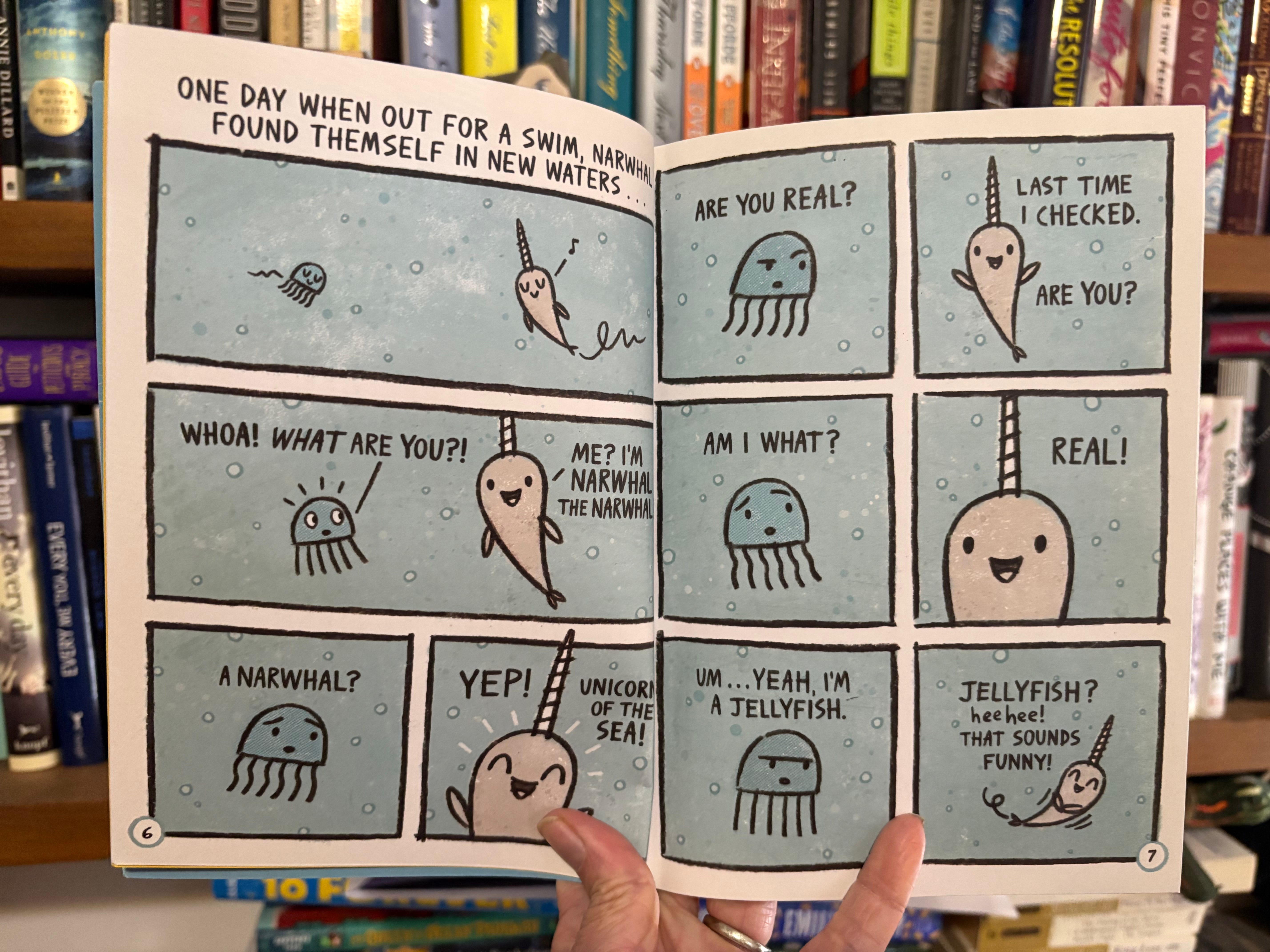
I don’t know where my first draft will go, if anywhere. But I am finding a ton of value in the process of creating it. I’m challenging myself to think in a new way as a storyteller. I’m discovering that a story’s overall parameters can stay the same, even as its shape changes. I’m pouring a square, structured narrative into a series of freeform vessels and massaging the plot and dialogue until it all seems to fit.
I am having fun.
To be frank, “fun” is not a word I’d use to describe most of my year thus far. (Amazing European vacation notwithstanding!) In that sense, finding a writing project I am intellectually and artistically invigorated by and genuinely enjoying working on has been quite a mood-booster.
So my challenge for you this week is, can you try something new with your creative work? Can you think about your work in a new way? Can you rewire your brain a bit? For me, taking an existing manuscript and putting it into a new format has made the whole endeavor seem a bit less daunting—but feel free to start from scratch, if that works for you. Just…try something new.
I’ll be over here with my first-draft graphic-novel script, cheering you on.
~Kathryn