
The Case for Community
Publishing books is a lot easier if you're not trying to get through it alone.

I did an author visit on Wednesday afternoon at a middle-school in Queens. The visit was with a sixth-grade after-school book club, 16 kids who’ve been reading The Thirteenth Circle. We did a version of my usual school visit activity, brainstorming science-fiction stories following my creative “recipe,” and then the kids got to ask me questions. Most of it was the usual Q&A fodder: Where do you get your inspiration? Have you always wanted to write books? How long does it take you to write a book? Have you ever thought about making your book into a movie?
But one student just wanted to know one important thing:
“Are you friends with Jason Reynolds?”
“Unfortunately, I’ve never met him,” I said, “but I really admire his work.”
The kid was disappointed. “Do you know any famous authors?” he asked.
I’ve been publishing books for over a decade. I know a lot of authors, with varying degrees of fame. And yet, questions like this always give me pause.
I’m a published author, but I would not call myself famous. I have so many incredible author-friends who also aren’t famous—and whose work should be more widely read than it is. While I do have some more well-known friends and acquaintances, it feels weird to scroll through my mental rolodex for the names most likely to impress a sixth-grader.
So I did what I often do when asked about who I know: I shifted the conversation to authors whose books I thought these kids might enjoy, if they weren’t already familiar with them. I asked what kind of stories the group liked, and I racked my brain for “readalikes”—similar kinds of characters and journeys. Of course, some of the books I recommended were written by my friends! That’s a thing author-friends can do for each other: hype up each other’s work. But sometimes the perfect book for a certain reader is by an author I’ve never met. (Sometimes, yes, someone quite famous.)
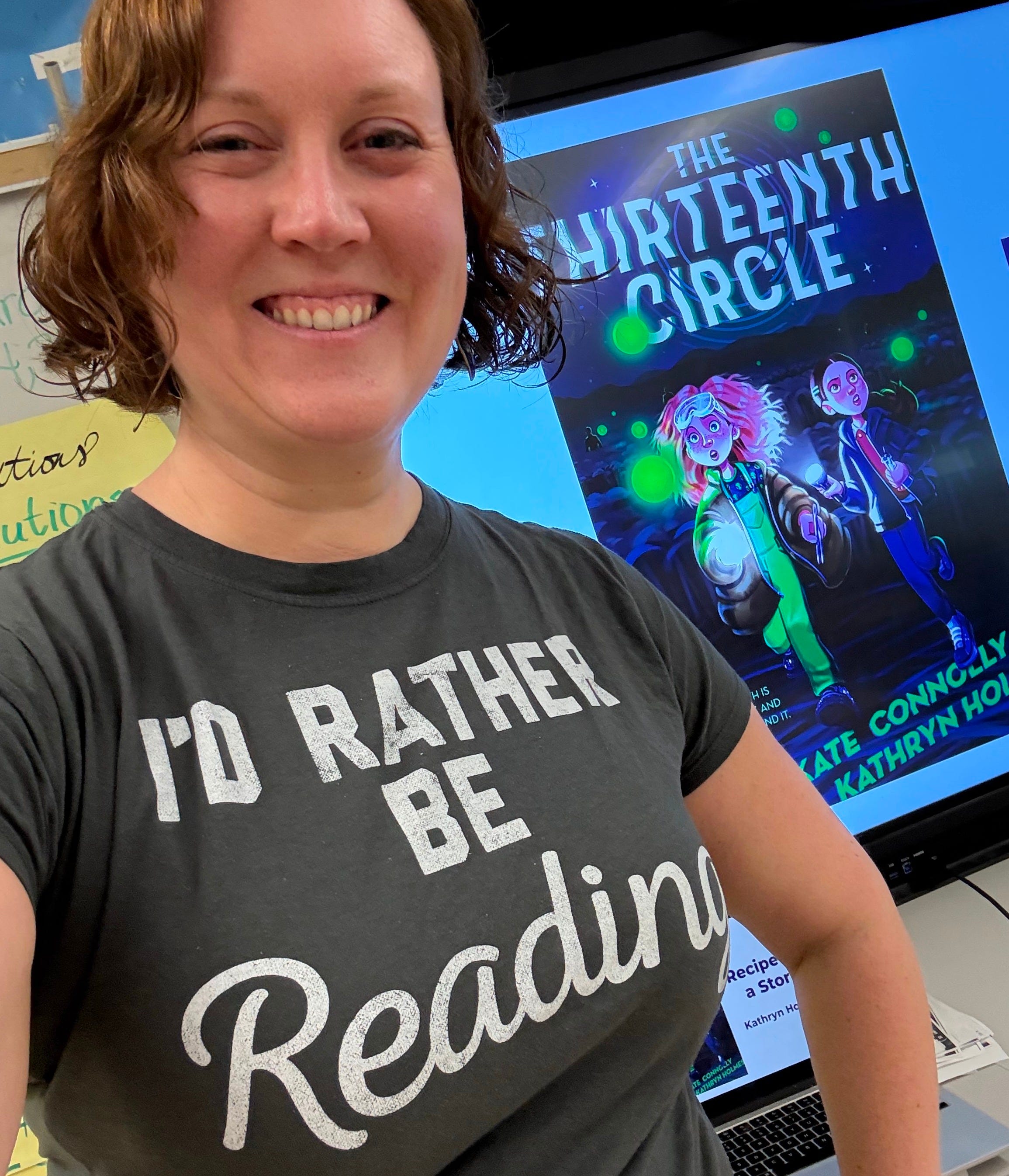
After that school presentation, I was left thinking about my author community. I have author-friends from graduate school. Author-friends who I met through the graduate-school network, even though we weren’t in the same cohort. Author-friends who published their debut novels in the same year as I did (2015), so we met as eager publishing newbies and stayed in touch in the years since. Author-friends I used to get together and write with, and author-friends I currently get together and write with. Author-friends who live in NYC, who I met at events or through other friends, and occasionally we all grab a meal together. Author-friends I only know online.
It’s a wide and diverse network—and one I’m always happy to add to.
Because if there’s one thing we need in this business, it’s a sense of community.
Writing a book is a solitary endeavor. Unless you’re working with a coauthor, like I was with MarcyKate Connolly for The Thirteenth Circle, it’s just you and your computer (or notebook, if you’re a drafting-by-hand person; I’m a laptop girlie). You are the only one who can write your book—who can tell the story the way you need to tell it.
But that doesn’t mean you won’t benefit hugely from building a community. Fellow writers can be idea-sounding-boards. They can help you work through sticky plot problems. They can read your manuscripts at various stages of the process and provide invaluable feedback. They can cheer you on toward each new milestone. They can commiserate with you when things aren’t going your way. And, as I mentioned above, they can spread the word about your book to people who need to hear about it.
Perhaps even more importantly, you can do the same for them, in return.
It’s not merely a give-and-take situation. I think community works best when everyone is making an effort to give more than they take. (With an acknowledgment here that we all have times where we don’t have much in the tank to give, or when we need our bucket refilled before we can refill someone else’s.) It feels really good to tell kids at school visits about my friends’ books. And I love beta-reading friends’ manuscripts, when my schedule allows. It’s nice to be able to offer advice in tricky or frustrating situations, or to simply be a listening ear.
The business side of publishing is most invested in its bottom line. While I won’t deny the necessity of that bottom line, we authors should be invested in our readers—and in each other. In our community. A rising tide lifts all boats.
I have another after-school author visit this afternoon, and I’m prepping my rec list for if I get asked who else I know in the industry or what other books these kids should be reading, besides mine. I’m thinking about so-called “famous” books and lesser well-known ones, authors who seem to be everywhere and authors who aren’t nearly as visible. And I’ll keep thinking about my kidlit community, and how what most of us want, most of all, is to get kids reading.
Until next week,
~Kathryn
Hi Kathryn, great article! Perfect timing… I’m back in the writing flow and ready to editing my grad school final project—you know the one—renamed The Adventures of Benito. Yesterday morning I found my edits for book 1 & outline for book 2… and in the afternoon I read your post. Let’s chat soon.
Love this. Thanks Kathryn!